


Your Writing Style Is a Business Asset. Start Treating It Like One.
Your writing style is a business asset — here's how to build one before the launch window closes including a practical mapping for different formats.
Phase 2 — Startup & Launch
How to start strong, find your voice, get press, stay compliant, and not blow the 180-day window most founders squander.
It is a Serial Entrepreneur's Playbook From Idea To Long-Term Success.
Style & Tone Tailor
Develop a unique writing style and tone. get guidance on language, structure, and stylistic elements to help craft a distinct writing identity.
Most founders spend months nailing their product's visual identity — logo, color palette, typography — then write their first investor email, customer announcement, or LinkedIn post in whatever voice happens to come out that morning. The result is a company that looks deliberate and sounds accidental.
That inconsistency costs you. In the launch window, every piece of writing is a signal. How you write tells investors, customers, and media whether there's a coherent mind running this thing. A crisp, distinctive written voice earns trust faster than a polished pitch deck. A generic one makes everything you say forgettable, no matter how good the underlying idea is.
Style and tone aren't aesthetic choices. They're operational ones. Here's how to develop yours before the launch window closes.
This article will help you through 3 things:
- How to find the right voice for you and your business
- How to match a tone of voice to a type of communication
- Easy actions you can take now to lock it in
Pillar 1: Personalized Style — Build a Voice That's Identifiably Yours
Style is the architecture of your writing. It's not about being clever or literary — it's about making deliberate choices that, repeated consistently, make your communication instantly recognizable as yours.
The Critical Styles & Where They Belong
Most founders write in one style by default — usually expository or informative, because those feel safe and professional. The problem is that safe and professional is indistinguishable. Understanding the full range of available styles lets you make an intentional choice rather than an accidental one.
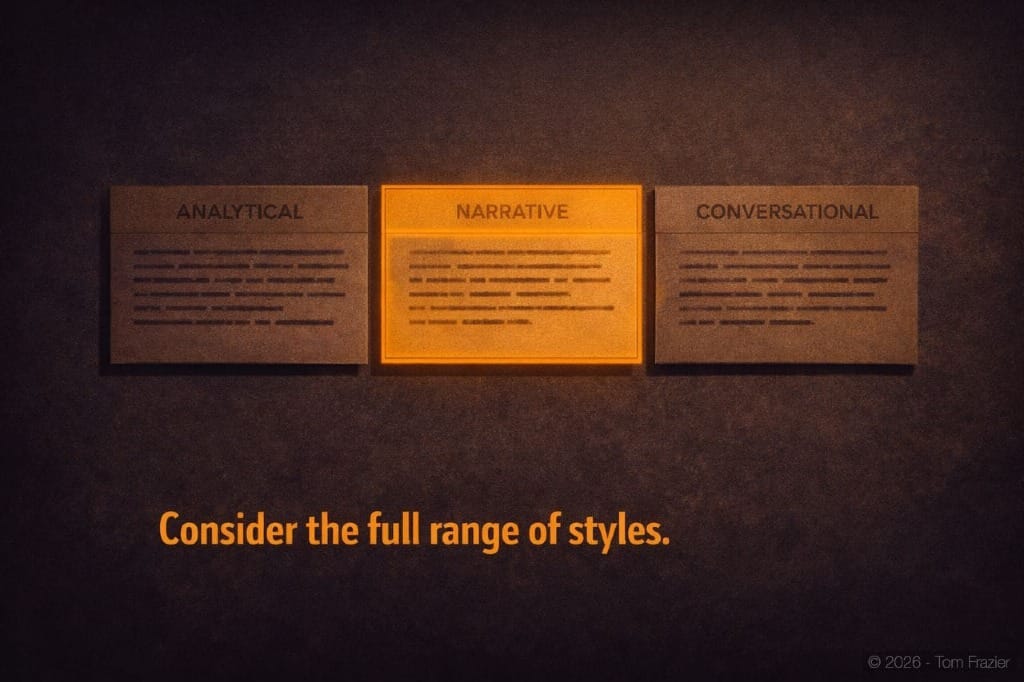
There are ~19 unique styles and here are the major styles that map to launch-stage communication:
- Analytical breaks complex ideas into parts. Use it for market positioning content, technical explainers to investors, and product architecture posts. This is where you demonstrate that you understand your category better than anyone else.
- Argumentative stakes and defends a position. Use it for thought leadership — any time you're publishing a view that challenges a prevailing assumption in your market. This is not "here's an interesting perspective." This is "the conventional wisdom is wrong, and here's why."
- Conversational mirrors everyday speech. Use it for onboarding emails, community communication, and social content where the goal is to close distance between you and the reader. Contractions are acceptable. Short sentences are preferred. The test: does it sound like something a person would actually say?
- Expository explains and describes. Use it for documentation, how-it-works pages, and educational content. This is the most overused style in startup communication — founders reach for it by default even when argumentative or analytical would serve better.
- Narrative tells a story. Use it for your founding story, customer case studies, and any content where you're trying to make someone care before you ask them to act. Data embedded in a story is remembered. Data presented as a table is forgotten.
- Instructive provides guidance and steps. Use it for product tutorials, onboarding sequences, and any content where the reader needs to do something specific after reading. The job of instructive writing is to reduce friction, not to impress.
- Journalistic presents information clearly and objectively. Use it for announcements, press releases, and factual updates. The inverted pyramid structure — most important information first — applies here. Editors and journalists you're pitching will notice if you write press materials that read like press materials.
- Persuasive drives action. Use it for calls to action, sales copy, and fundraising narratives. The key distinction from argumentative: persuasive writing moves the reader toward a specific decision. The argument is in service of the ask.
- Epigrammatic uses concise, pointed language. Use it for taglines, social media hooks, and key messages you want to be quoted or repeated. This is the hardest style to execute and the most valuable when done well. Every word either earns its place or gets cut.
Identify Your Default — Then Choose Better
The fastest way to identify your natural writing style is to pull three pieces of writing you've produced without thinking much about it — a Slack message to your team, an email to an investor, a LinkedIn post. Read them against the list above and name what you find.
Most founders discover one of three patterns:
- They default to expository everywhere — even in contexts that need persuasion or argument. Their writing explains what things are without making a case for why they matter.
- They default to conversational everywhere — even in contexts that need authority and precision. Their writing reads as approachable but not credible.
- They default to formal everywhere — even in contexts that need to close distance. Their writing reads as competent but cold.
Once you've named your default, you can make a deliberate choice. That choice should be driven by a single question: what does the reader need to do or feel when they finish reading this? The answer determines the style. The style serves the purpose. Not the other way around.
Building Your Style Specification
A style spec is not a brand guidelines document. It's a short, operational reference that tells anyone — including an AI writing assistant — exactly how to produce writing that sounds like you.
A working style spec contains five things:
Voice descriptor sentence
One sentence that captures the voice in concrete terms. Not "authentic and professional." Something like: "We write like an operator who has seen the inside of twenty companies and is giving you the honest version — not the investor deck version." That sentence is testable. Someone can read a draft and ask: does this sound like that?
Style-by-format map
A table that pairs each content type you produce with the style it should use. Blog post = analytical/argumentative. Welcome email = conversational. Investor update = journalistic/informative. LinkedIn post = epigrammatic/argumentative. Customer case study = narrative. This removes the decision from every individual piece of writing.
Structural defaults
Sentence length preference (short for hard points, longer for context). Paragraph length (3–5 sentences). Leading with the conclusion vs. building to it. Use of contractions. First or second person. Lists vs. prose. These are defaults, not rules — but they should require a deliberate override, not a default drift.
The cut list
Phrases and patterns that appear in your writing by default but shouldn't. Compile yours honestly. Common entries: "It's worth noting that," "Leverage," "Ecosystem," "Exciting," "Game-changer," "In conclusion," "At the end of the day," passive voice in any announcement, rhetorical questions used as transitions ("So what does this mean for you?"), and vague intensifiers like "very," "quite," and "somewhat."
The test question
One question you ask before finalizing any piece of writing. "Does this sound like it could have been written by a committee?" "If I removed the company name, would this still obviously be us?" "Would I be comfortable if the best writer I know read this?" Pick one. Apply it to everything.
Pillar 2: Tone Analysis — Calibrate the Register, Not Just the Words
Voice is who you are in writing. Tone is how you show up in a specific context. You have one voice. You use many tones.
The mistake founders make is treating tone as decoration — a dial that goes from "warm" to "formal" based on audience. Tone is more precise than that. Getting it right requires understanding the full set of tonal options and the conditions that call for each.
The Tonal Spectrum
There are dozens of distinct tones available to a writer. Knowing them by name lets you make intentional choices instead of accidental ones. Here are the heroes:
- Authoritative — commanding and confident, conveying expertise. Use for market analysis, strong opinion pieces, and any content where your credibility is the point. Risk: slides into arrogance without evidence to back the confidence.
- Clinical — detached and precise, fact-forward. Use for technical documentation and any content where emotional distance is appropriate. Risk: reads as cold in contexts that require human connection.
- Confident — self-assured without being authoritative or cold. This is the default tone for most launch-stage communication. "Here's what we built and why it matters." No hedging. No over-qualification.
- Cynical — skeptical and distrustful by default. Use sparingly and intentionally — usually in market commentary where the conventional wisdom deserves challenge. Risk: chronic cynicism reads as unconstructive and alienates readers who want direction, not just criticism.
- Empathetic — acknowledges the reader's experience or difficulty. Use in customer communication, onboarding, and any content that addresses a problem the reader is currently feeling. This is not warmth for warmth's sake — it's the recognition that your reader has stakes in what you're writing about.
- Formal — polished and professional, appropriate for ceremonial or high-stakes contexts. Use for legal communications, board updates, and any context where tone violations carry real cost. Formal does not mean stiff — it means precise and considered.
- Friendly — warm and approachable, minimizes distance. Use for community content, conversational emails, and social content where likability precedes credibility. The risk is inconsistency: founders who default to friendly in casual contexts and then shift to cold in commercial ones create trust gaps.
- Humorous — lightens the register, builds rapport. Use strategically and sparingly at launch — usually in social content, internal communication, and brand moments where you're trying to signal humanity. Risk: humor in the wrong context reads as unserious. A funding announcement that tries to be funny usually fails.
- Informative — conveys facts without evaluation. Use for product updates, factual announcements, and any content where your job is to transmit information accurately, not to editorialize. This tone pairs naturally with journalistic style.
- Optimistic — expects and projects positive outcomes. Use in vision content, fundraising narratives, and brand storytelling. The risk at launch: optimism without evidence reads as naive. The goal is optimism grounded in a specific argument — not cheerleading.
- Serious — focused and earnest, signals that the stakes are real. Use for crisis communication, heavy market topics, and content addressing problems with genuine human cost. This tone is often underused by founders who are trying to keep things light.
- Tentative — uncertain and hedging. This is almost never the right choice for a founder's external communication. It appears when someone isn't sure whether a claim is defensible. The fix is not to soften the claim — it's to remove it or verify it.
Tone by Format: The Practical Mapping
The following combinations are what work at launch:
| Format | Primary Tone | Secondary Tone | Never |
|---|---|---|---|
| Investor update | Confident | Informative | Tentative, humorous |
| Product launch | Confident | Optimistic | Cynical, clinical |
| Welcome email | Friendly | Empathetic | Formal, authoritative |
| Documentation | Clinical | Informative | Humorous, emotional |
| Thought leadership | Authoritative | Confident | Tentative, friendly |
| Press release | Informative | Formal | Humorous, cynical |
| Social media | Confident | Conversational | Clinical, formal |
| Service outage | Empathetic | Serious | Humorous, optimistic |
| Sales copy | Confident | Persuasive | Tentative, cynical |
| Founding story | Narrative | Empathetic | Clinical, formal |
Diagnosing a Tone Problem
When a piece of writing isn't landing, the problem is usually one of three tone failures:
Register mismatch
The tone doesn't match what the reader expects in that context. A warm, friendly tone in a cold outreach email to an enterprise buyer reads as unprofessional. A formal tone in a community forum reads as distant. The reader's context expectations are not negotiable — your tone has to meet them.
Inconsistency within a piece
The writing starts confident and ends tentative. Or it opens empathetic and shifts to clinical halfway through. The reader experiences this as confusion — the writer doesn't seem sure of themselves. Pick the primary tone before you write the first sentence and hold it.
Confidence deficit
The most common tone problem in founder writing. It manifests as hedging ("we believe," "it seems," "it might be the case that"), over-qualification ("in many cases," "for some users"), and conclusions that trail off instead of landing. The fix is blunt: state the claim. Cut the hedge. If the claim is true, own it.
The Action Layer
In the next 48 hours:
- Pull three pieces of writing you produced without deliberate thought. Name the style and tone of each using the frameworks above. Notice the default patterns. That audit tells you what you're working with.
- Write your voice descriptor sentence. One sentence. Testable against any draft you produce. "We write like [specific description]." If you can't write it, you don't know your voice yet — and that's useful data.
- Build your format-to-style map. List every content type you produce or plan to produce at launch. Assign a primary style and a primary tone to each. This takes thirty minutes and eliminates a decision you'd otherwise make by default hundreds of times over the next year.
Start your cut list. Five phrases that appear in your writing that should never appear again. Write them down tonight.
The window for establishing your communication identity is narrow. At launch, everything is new — your product, your company, your market position. That newness is when readers form their first impression of who you are. Write like you mean it.
Define your unique perspective. A free AI tool just for subscribers. ⤵️
This article is why I built the Style & Tone Tailor GPT. It is designed to assist users in developing a unique tone of voice and writing style.
It provides guidance on language, structure, and stylistic elements to help users craft their distinct writing identity
Common Questions About Style & Tone Tailor
What if I'm not sure about the writing style I need?
Style & Tone Tailor helps explore and define a unique writing style by analyzing preferences and providing guided feedback and examples.
Can it handle different tones for diverse audiences?
It adeptly adjusts tone to suit various audiences, ensuring the message resonates appropriately with each specific group.
What if my writing style is inconsistent?
It identifies inconsistencies in writing and offers suggestions to achieve a more cohesive and effective style.
How can it help if I'm not a naturally creative writer?
It provides creative guidance and inspiration, helping to enhance writing with originality and imagination.
Is it suitable for professional or technical writing?
It is well-equipped to assist with professional and technical writing, focusing on clarity, precision, and appropriateness for the context.
This post is for subscribers only
Sign up now to get access to the post.
Already a member? Sign in